The Contagion of Worry: A Tale of Collective Anxiety
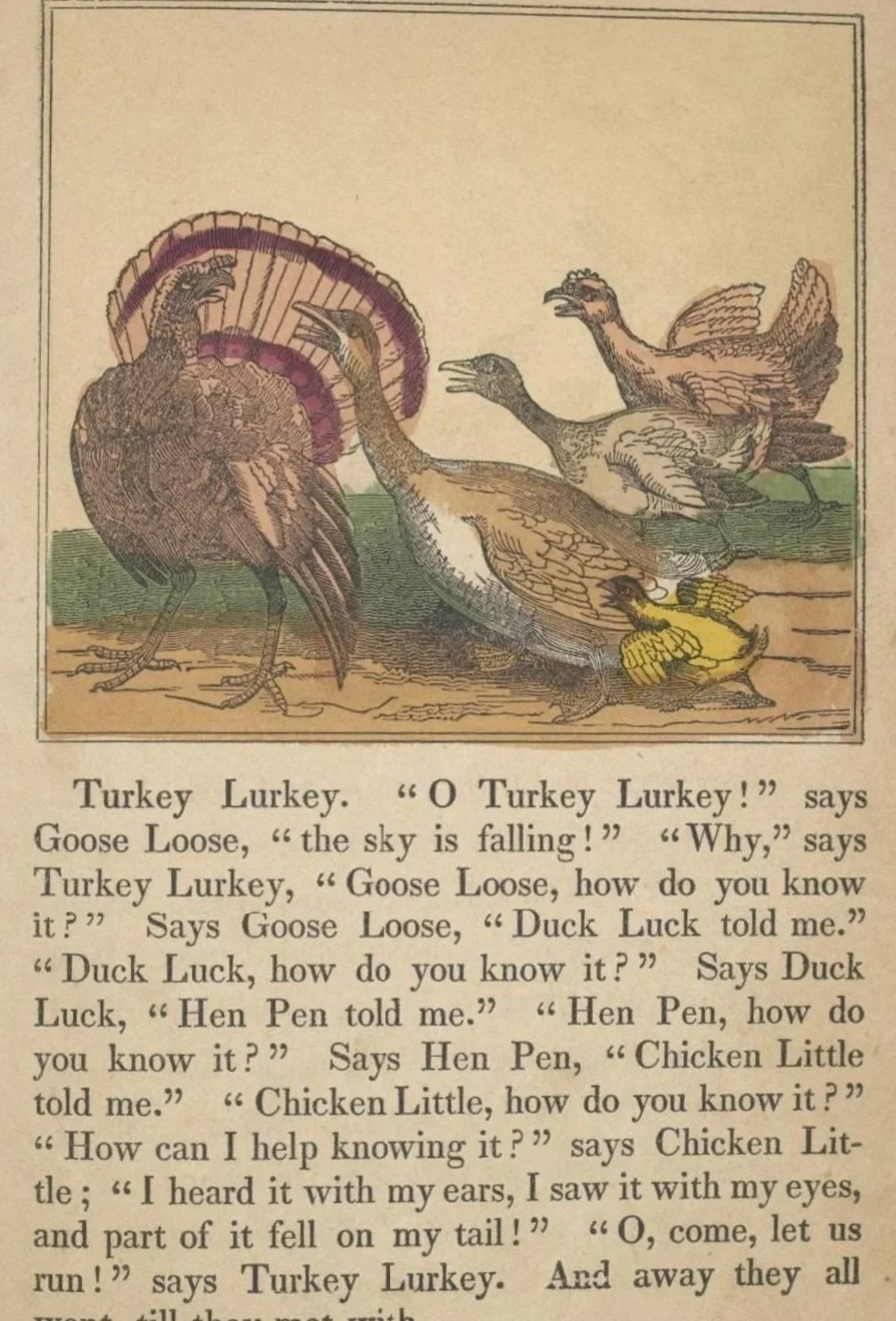
Image: Illustration from The Remarkable Story of Chicken Little (1840) by John Greene Chandler / Benjamin R. Mussey, Publisher / Public Domain
Several days ago, a disturbing headline sent me into an anxious spin. From a single news story, my mind spun a dozen scary versions of what might happen next. Flooded with the stress hormones, adrenaline and cortisol, my brain went into overdrive, worries popping off like firecrackers, my anxious mind preparing for every “what if.” Our rational mind tells us worry is wasted psychic energy, but worry is a difficult habit to break.
Psychologist Albert Ellis, creator of Rational Emotive Behavioral Therapy (REBT), first used the word “catastrophe” as a verb—to catastrophize—in his 1962 book Reason and Emotion in Psychotherapy. Catastrophizing is a habit of mind. Catastrophic worriers turn minor dilemmas into worst-case scenarios. Imagining the worst arises from a protective instinct that aims to prepare us for future threats. Worry and fear are bedmates. Fear is a physiological reaction focused on a perceived immediate threat; worry is a thought process; worry is our brain thinking about what it fears.[1]
In this era of major rapid upheavals, we have our personal fears — worries about ourselves and those we love — but we are also swimming in a sea of communal fear. We can ask ourselves: Whose fear is this? Is it authentically mine, or have I been influenced by the alarm of others?
Fear spreads through unconscious and biological processes. Like other mammals, we can smell fear on each other. Frightened humans release chemical signals in their sweat. When others smell this compound, it directly activates the amygdala, the threat detector in the brain. We also monitor other people’s facial expressions, posture, and voice, and unconsciously mirror their distress. As social creatures, high-arousal negative emotions like fear can also act as a survival bond, as in the case of war or a natural disaster.[2]
Henny-Penny is the quintessential story about the social contagion of mass hysteria and the catastrophizing mind.
One day, Henny Penny (better known as Chicken Little in the United States) is in the barnyard pecking at a kernel of corn when an acorn bops her on the head. Startled, Henny Penny concludes the sky is falling. She decides she must go tell the king.
In her distress, she runs to warn the other barnyard animals. — The sky is falling!, The sky is falling! — spreading panic about a collapsing sky. The urgency in her voice, her palpable alarm, recruits Cocky Locky, Ducky Lucky, Goosey Loosey, and Turkey Lurky. Without thinking for themselves or questioning what actually hit Henny Penny’s head, her barnyard mates fall in with her distortion of the truth. In the older, darker version of the fable, Foxy Loxy lures the panicked animals into his den and eats them before they can reach the king, providing the moral that panic impairs your judgment and makes you vulnerable as prey.
A related tale is Aesop’s fable of “The Boy Who Cried Wolf.” In this tale, a mischievous shepherd boy cries Wolf! Wolf! many times when no wolf is present. With each of his outbursts, the townspeople rush up the hill to save the flock. But when a wolf finally does appear and threatens the sheep, the people think it is another false alarm, ignore the boy’s pleas, and the wolf eats the sheep, and, in some versions, the boy. Aesop’s moral: a liar is not believed even when he is telling the truth. But recent studies have linked this story with a more troubling phenomenon: alert fatigue, as when a high number of health alarms desensitizes medical professionals to a health threat.[3]
These are tales for our time. When we hear urgent voices on social media and other venues screaming for our attention, propagating alarm and mistruths, it’s wise to calm our nervous system with some deep breaths, slow down our thought process, pause, and ask: Is this true? Did this actually happen? What is the evidence? (Is what hit me on the head a piece of sky or an acorn?) We can ask ourselves what fear is being promoted, by whom, and for what reason. Is someone else’s panic being transmitted to me? Who does this fear benefit?
For our worry-minds, advances in psychology, psychiatry, neuroscience, and spiritual practices offer help.[4][5] As does our creative self. In fact, it was precisely for this reason—to calm my fears—that I wrote the fairy tale in my new book, Wild Freedom.
Write your own fable about fear. Be curious. See what you can discover!
[1] Catastrophizing, Psychology Today
[2] Houran, James, et al., “The spread of mind: psychological contagion in theory and critique,” Frontiers in Psychology, 20 November 2025.
[3] Harlow, Kevin, “Alert Fatigue in Healthcare: Causes, Consequences, and the 2026 Technology Fix,” ClinicianCore, May 15, 2026
[4] “How to Fight Catastrophic Thinking,” Psychology Today
[5] Borland, Adam, “Your Emotions Are Contagious,” Cleveland Clinic Health Essentials, August 21, 2025.
If you found this post interesting, you may also want to read
