The Sad Child and the Inner World of Abandonment
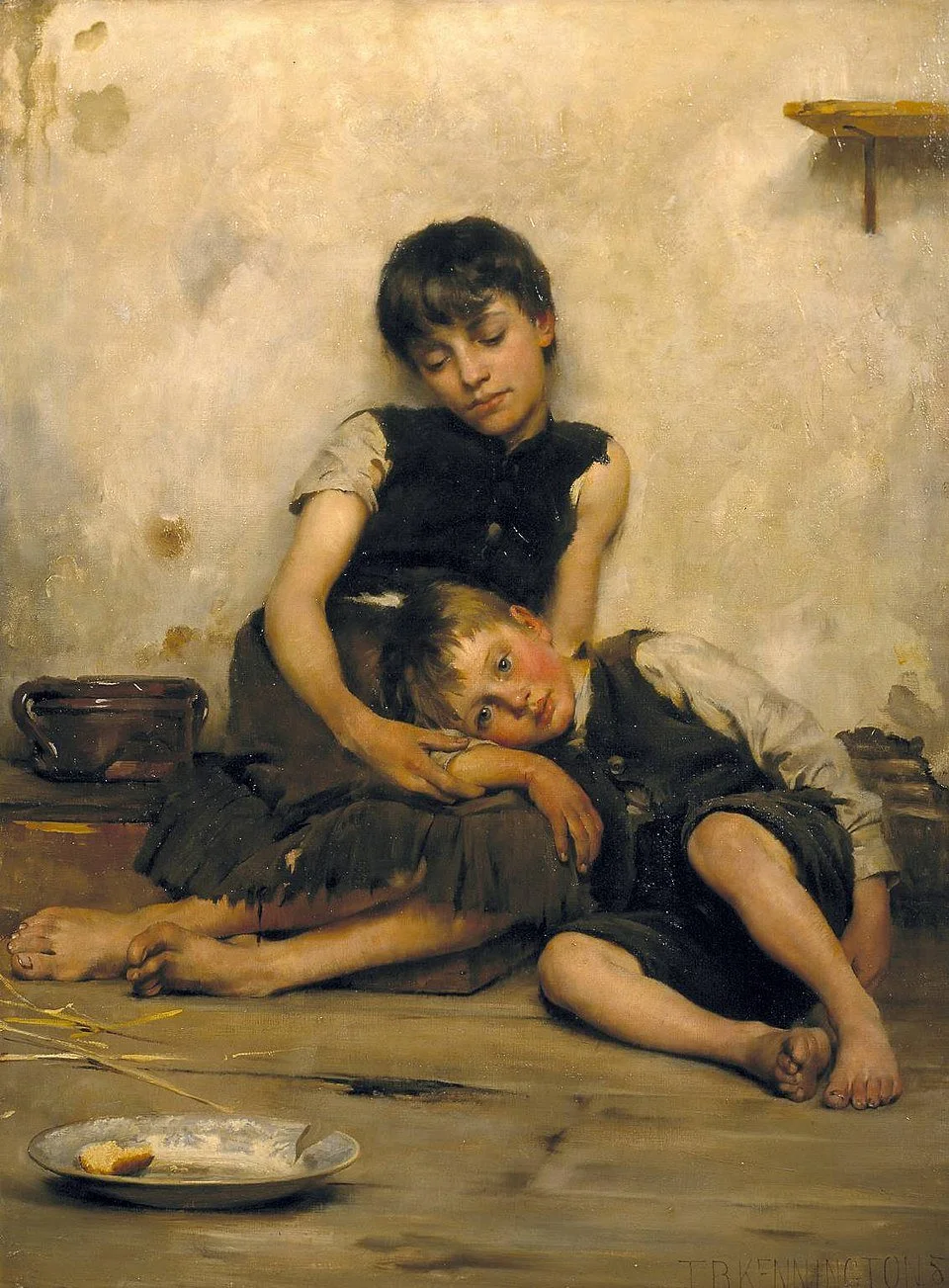
Image: Orphans (1885) by Thomas Benjamin Kennington (1856-1916) Source: Tate Britain/ Public Domain
One fine spring day when I was a child of about six, I discovered a newborn kitten under the bushes in our yard. The kitten was nearly bald. Its eyes were squeezed shut, and there was something terribly wrong with the shape of its head. I ran to find a blanket to wrap it and carry the struggling newborn into our house, but my mother stood in the doorway, forbidding me to enter. “Something is wrong with it, and that’s why its mother left it to die,” she said.
My mother’s words struck a chord of terror. How could a mother abandon its sickly offspring? Too young to understand Darwinian theory—the survival of the fittest—I absorbed the cat’s abandonment of its kitten as an epic lesson in the cruelties of nature—and of my helplessness to provide protection.
This is my first memory of a core human fear: abandonment. Fears of abandonment ignite our most primal horror of being alone in a hostile world without the means to survive and thrive. Compared to other mammalian species, human newborns are extremely helpless at birth and for years after. Unlike horses, giraffes, whales, and other mammals that can run, swim, and find food days after birth, humans are neither sighted nor mobile at birth and are entirely dependent on an adult for basic survival.[1]
Our fear of abandonment lurks in the hidden recesses of our unconscious mind. Images of abandoned children that come to us in dreams indicate the repressed inner child and her unmet and unrecognized needs. Dream images might include a child lost in the deep woods, a starving baby stuffed into a drawer that has been forgotten, or a youngster wandering in an unlit and unfamiliar neighborhood. These symbolic images evoke feelings from our distant past, not necessarily real events, yet provoke real emotions. They offer a profound knowledge of our unconscious predicament and the state of our inner child.[2]
The word mourning stems from the same root as the word memory[3]: the abandoned child mourns for what she never had or has lost. Her total dependence on the absent or neglectful other is experienced as deprivation.[4] Turned inward, the lack of a strong and reliable protector can translate as self-blame and depression. Inconsistent nurturing, misattunement, unpredictable or unreliable caretakers, as well as the death of a parent, open us to feelings of emptiness, futility, and hopelessness. The child believes he has been abandoned for a good reason, and it is all his fault.[5]
Physical abandonment is depicted in many of our foundational stories, from Moses in the Bible to the tales of Hansel and Gretel or The Little Match Girl. Many novels by Charles Dickens offer sentimental portrayals of orphaned or abandoned children, Oliver Twist and David Copperfield, to name two. More recently, prize-winning author Barbara Kingsolver has reimagined David Copperfield as Demon Copperhead, and another prize-winning author, Colson Whitehead, gives us the story of the orphaned and abused Nickel Boys.
We are endlessly fascinated by the plight of the rejected and abandoned children in the Brothers Grimm’s fairy tales and in the struggles of contemporary abandoned children. Something in their distress reverberates in our souls. In our most cherished stories, the abandoned child is also a hero who endures hardship and develops extraordinary skills of self-reliance. At the heart of these characters, as in life, is an internal sense of self-worth, of feeling valuable, a deep core belief that “I am a valuable person.”
Abandonment takes many forms—physical and emotional—but one of the most insidious types of abandonment is not a result of the loss of another but a defection from oneself. Self-abandonment is a survival strategy of children who choose loyalty to the other over loyalty to themselves. A child in this situation represses her own needs to win the affection or care of a necessary adult.[6] The child experiences his own needs as dangerous. To avoid conflict or abandonment, this child succumbs or appeases the dominant person to gain love and safety, essentially cutting themselves off from their own creative powers and life force.[7] What is crucial to remember is that while our life force may go underground and feel inaccessible, an apt description of depression, nonetheless it remains an ever-giving spring available to water our parched souls.
In this time of great disarray and disunified societies, even as adults, we may feel the tug of abandonment fears. Planet Earth, after all, is our Great Mother, the source of our nourishment and survival. If she is in jeopardy, we are in jeopardy. Now may be an important time to watch your dreams for images of forgotten, lonely, or lost children, of abandoned houses or empty rooms where a child once lived. If these or other evocative images appear, pay attention. What is the child in your dreams expressing? What are her needs? Who once inhabited the empty room, the empty house, and who seeks to return to find herself, playful and fulfilled again?
[1] Nemo, Leslie, “Why Baby Animals Can Walk So Much Sooner Than Human Infants,” Discover, May 8, 2021.
[2] “Understanding Dreams,” Psychology Today
[4] Cruz, Daniel, et al., “Developmental Trauma: Conceptual framework, associated risks and comorbidities, and evaluation and treatment,” Frontiers in Psychiatry, July 2022.
[5] Wood, Katrina, “Trauma and the Impact of Misattunement in Early Childhood,” Journal of Psychiatry Reform, January 2024.
[6] Woodall, Karen, “Self Alienation; The Underlyiing Trauma for Children Who Align and Reject,” karenwoodall.blog. April 2023
[7] Miller, Alice, “The Search for the True Self,” Reclaiming the Inner Child, edited by Jeremiah Abrams, Tarcher, 1990.
If you found this post interesting, you may also want to read
