Dream Wisdom: A Guide to Self-Discovery
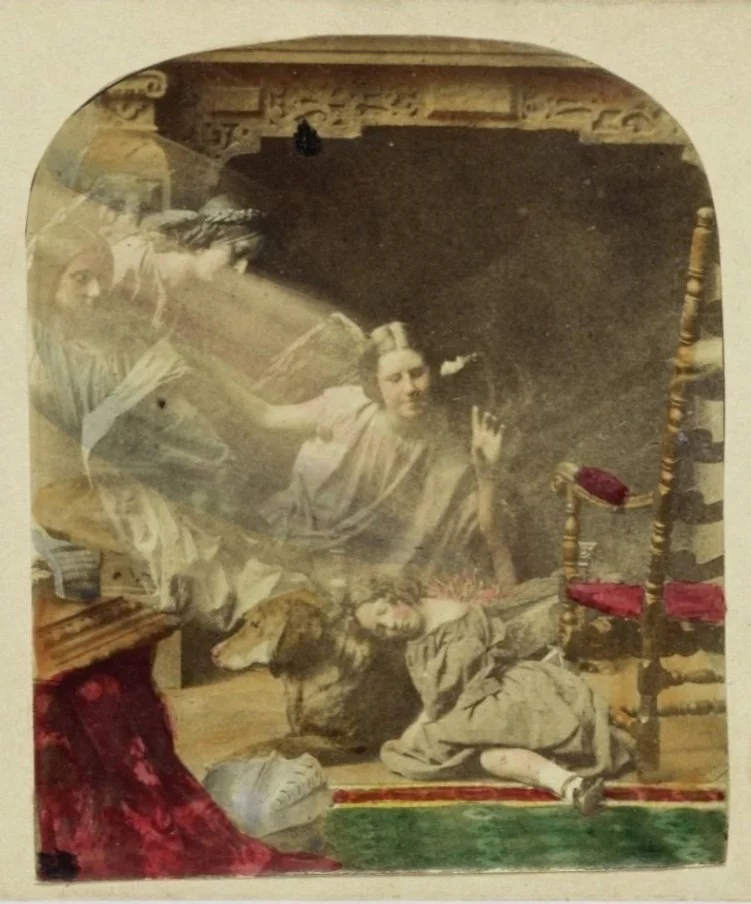
Image: The Orphan’s Dream (1856-1861) stereograph (detail) by James Elliott (1835-1903). Rijksmuseum / Public Domain
Humans have been fascinated, inspired, and guided by dreams since our earliest history. Our ancestors regarded dreams as messages from the divine and considered them bridges between the ordinary and spiritual worlds. Dream interpretation was sacred to the Aztecs, Mayans, Egyptians, Greeks, Indigenous Peoples of the Americas, and African peoples, among others, who looked to dreams for guidance on life and death issues such as health and preparation for impending disasters.
Although prophetic dreams appear in the Bible, the early Church forbade congregants from connecting with God through dreams unless a priest mediated.[1] In the Middle Ages, dreams were often considered the work of the devil. During the Salem witch trials, the accuser claimed the accused witch visited them in dreams and tried to choke or kill them. Enlightenment philosophers and thinkers, René Descartes and John Locke among the most famous, viewed dreams as neither messages from God nor a visitation from Satan. In his Meditations on First Philosophy, Descartes argued that dreams mimic reality but are not reality and we cannot trust our senses to attain the truth. Sensory information therefore was not reliable.[2]
Yet despite the rational skepticism of the seventeenth and eighteenth centuries, dream manuals circulated among both Christians and Jews. Tibetan Buddhists had elaborate visualization and meditation practices for cultivating dream states like lucid dreaming. The mystical branch of Islam, Sufism, likewise took a great interest in dreams. Spiritual masters examined seekers’ dreams to evaluate their emotional state and map out complex spiritual guides for dreamers.[3]
The evolving science of medicine and the natural sciences sparked curiosity in the physiology of dreaming: Where do dreams originate? What’s happening in our brain and body when we sleep? What are the different dream states? In 1899, Sigmund Freud published his seminal book, The Interpretation of Dreams, which introduced his new psychoanalytic theory of consciousness, a model that he later refined when he divided the psyche into three parts—conscious, the ego; unconscious, the Id; and the moral arbitrator of our minds, the super-ego.[4]
Freud believed our forbidden fantasies and sexual desires were repressed by a censor while we are awake. During sleep, the censor relaxes and the repressed, unacceptable contents of our unconscious become disguised in dreams whose symbols needed to be decoded with the aid of a trained psychoanalyst acting in a secular role once held by a priest.
Carl Jung, originally Freud’s devoted student and later his professional rival, was, like his teacher, devoted to understanding the unconscious. Both believed dreams were an expression of the unconscious and an active dynamic force in shaping our waking life. For Jung, dream phenomena could not be reduced to repression of sexual drives and libido. He understood dreams to serve a compensatory purpose. Dreams showed us neglected or rejected unconscious aspects of ourselves, our “shadow.” Dream imagery might emphasize what is hidden from our awareness, not only forbidden instincts and desires, but also forgotten memories and archetypal symbols that have appeared in dreams since the beginning of humankind.
“The general function of dreams is to try to restore our psychological balance by producing dream material that re-establishes, in a subtle way, the total psychic equilibrium. This is what I call the complementary (or compensatory) role of dreams in our psychic make-up.”—Carl Jung, Man and His Symbols.[5]
The emotional depth of this material emerges in dreams unfiltered by conscious restraint. In a compensatory dream, a person who was passive and compliant in daily life might dream they are an aggressive raging lion, symbolizing unacknowledged and split-off anger. Jung believed dreams show us where we are out of balance and help to restore wholeness to our psyches. For Jung, dreams could be interpreted objectively—the typewriter in a dream represents the typewriter in your office; or subjectively—the typewriter in your dream represents your mother’s underpaid job as a secretary; or archetypally—the typewriter in your dream represents an authorial voice and commitment to language that must be hammered out on an outdated mode of communication. Jung and his followers held that making the unconscious conscious led to the discovery of our authentic selves.[6]
Freudian and Jungian theories continue to evolve today. Neuroscience has advanced our understanding of dreaming and is exploring the brain physiology involved.[7] Research on the use of psychedelics—psilocybin, ayahuasca, MDMA—has inspired new interest in consciousness, in altered states including dreams, and their influence on our well-being.
If you are interested in dreamwork and exploring the meaning of your rich inner world and symbolic life, many teachers and ways of working with dreams exist. This includes depth psychology work, traditional psychoanalysis, sand tray therapy,[8] dance therapy, shamanic and indigenous traditions, and spiritual and wisdom teachers.
Or be your own guide. If you have a problem to solve, an issue to process, or are looking to explore the liminal state of dream reality, set your intention before you go to sleep by asking the dream-maker to send you the information you’re seeking. Even if you remember only a single word or image from a dream, record it immediately upon waking, while the dream is fresh. Contemplate its meaning. Drawing, sculpting, painting, or dancing a dream can also provide insight by circumventing language and engaging with the dream's lived feeling.
Consider dreams as wondrous gifts that come to us purposefully and without effort. Consider that their message can be both personal and collective. Be receptive to the mystery! Each dream is an adventure into a different reality, or as Jung wrote, “The dream is a little hidden door in the innermost and most secret recesses of the soul.”[9]
[1] Bulkeley, Kelly, “Dream Interpretation in Christianity: A Brief History,” Kelly Bulkeley blog, September 16, 2011.
[2] Simpson, Peter L., “The Dream Argument and Descartes’ First Meditation,” Auslegung: a Journal of Philosophy, December 1982.
[3] Nasr, Seyyed Hossein, The Garden of Truth: The Vision and Promise of Sufism, Islam’s Mystical Tradition, HarperCollins, 2007.
[4] Freud, Sigmund, The Ego and the Id, W.W. Norton, 1923
[5] Jung, Carl, Man and His Symbols, Random House, 1964., p. 617
[6] Jung, Carl, General Aspects of Dream Psychology, Collected Works, V8, Princeton University Press, 1948
[7] Mutti, C., Siclari, F., Rosenzwig, I., “Dreaming Conundrum,” Journal of Sleep Research, October 3, 2024.
[8] Pedersen, Traci, “What Is Sand Tray Therapy?” PsychCentral, October 7, 2021.
[9] Jung, Carl, in “The Meaning of Psychology for Modern Man,” Civilization in Transition, Collected Works, V10, Princeton University Press, 1933. p.144
If you found this post interesting, you may also want to read
