Who Am I? Replacement Children and the Quest for Identity
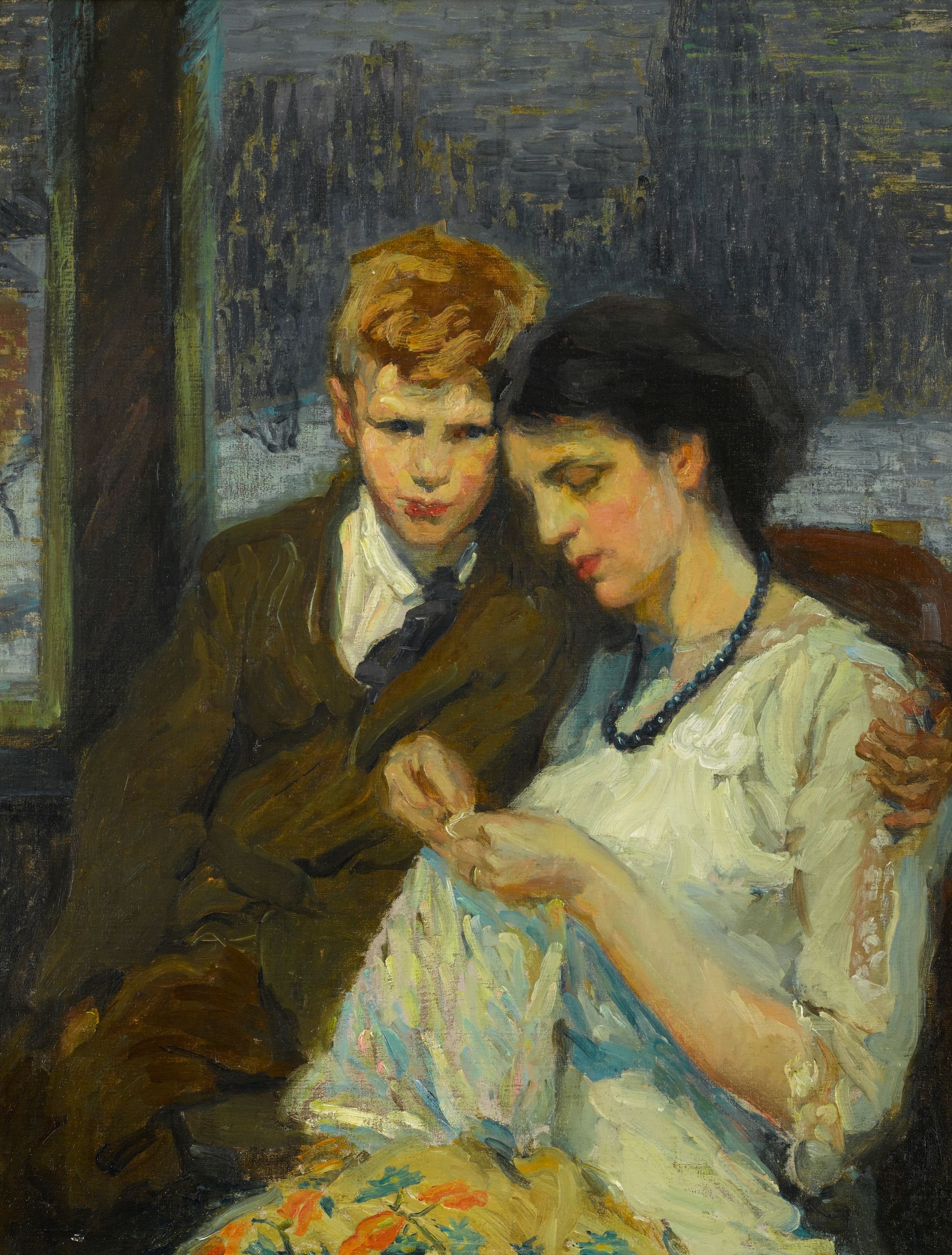
Image: Mother and Son (c 1910-1915) by Alice Schille (1869-1955) Nedra Matteucci Galleries /Public domain
This continues the discussion of replacement children from the previous post, “Do You Feel Like a Replacement Child?”
The origin of the word “identity” comes from the Latin identitas and suggests “sameness with others,” that is, our identity is both an individual self-concept and a collective one. Identity forms early in life, is fluid, evolving, and contextual. This is my hand, my foot, my voice, my dream, but I am also a we. I identify with an ethnicity, a gender or non-binary, a nationality, politics, class, occupation, and sexual preference. British psychoanalyst Donald Winnicott posited that beneath these defining external factors we have a true self, an “I” that hides its individuality and vulnerability by developing a protective false self which conforms to the demands of society.[i]
The dichotomy between who we feel ourselves to be and the façade we adopt heightens the possibility of emotional struggles and is an especially fraught experience for replacement children. Each acorn grows into a unique oak tree. Just so, every human has the potential to develop into a unique personality, an individual self with their own quirks, natural abilities, and talents. But replacement children grow up under the shadow of the missing other, which shapes their development and their ability to be anchored in their own life force. A major identity issue confronting replacement children is the need to uncover and embody their authentic selves.
Our awareness of our personal identity develops over a lifetime. The universal quest centers on the question Who am I, really? For the replacement child, identity is overlaid with obsessive thoughts about a dead family member they were conceived to replace. Replacement children may wonder: Who am I if I am not the golden child who will cure my parents’ suffering? Who am I if I am not the savior child who will bring new life and joy to this family? Who would I be if I were not conceived to substitute for the dead?
Replacement children are burdened by the need to be good, to self-sacrifice, to compensate for the loss of a previous child. Adept and highly sensitive to recognizing and fulfilling the needs of others, they are prone to neglecting their own needs.
In an unconscious attempt to cure their parents’ unresolved grief, replacement children often struggle with perfectionism and overachievement. Alice Miller, in her classic book The Drama of the Gifted Child: The Search for the True Self, explains that the parentified[ii] child becomes the caretaker for the adults, a role reversal in which the child comforts and nurtures their parents. Given an impossible task— the inability to heal or make up for family trauma—feelings of not being good enough feed a self that is vulnerable to shame and guilt.[iii]
An example of this occurs in Nobel Laureate Annie Ernaux’s memoir, The Other Girl, written as a letter to the dead older sister whom she never met but whose presence haunted her childhood. Ernaux speaks for many replacement children, aware she may not have been conceived if her sister had not died. “So you had to die at six for me to come into the world and be saved.”
Like many replacement children, Ernaux’s survivor’s guilt is tinged with anger and remorse. She is aware, as many replacement children are, that if her sister had not died, she would not exist. She questions whether her mother’s love was really for her or for her dead sister. As an adult reflecting on the shocking discovery of her sister’s existence, she admits:
“I’d been living in a state of illusion. I was not unique. There was another girl who’d sprung out of nowhere. Therefore, all the love I thought I was receiving was false.”[iv]
A grieving mother may be unable to adequately care for or bond with her replacement infant. In an effort not to lose another child, she may become overprotective and anxious, or depressed and unable to feed and comfort her baby. A mother in the throes of unintegrated bereavement may alternate between over-attentiveness and withdrawal, confusing the infant who becomes at risk for developing anxious-ambivalent or insecure attachment styles which profoundly shape later relationships.
About her parents Ernaux writes: “I don’t blame them for anything. The parents of a dead child don’t know what their pain does to the one who is living.”[v]
Psychoanalyst Kristina Schellinski is an authority on replacement children. In her book, Individuation for Adult Replacement Children: Ways of Coming into Being, Schellinski relates the stories of some of her patients, the existential insecurity and identity wounds expressed by adult replacement children in her consulting room. Even into their sixties, seventies, and eighties elderly replacement children seek self-validation. One patient admits she feels she “has no roots.” Another confesses a feeling of losing herself, and another of facing a void or an abyss. The healing path for each of these patients was deep engagement with their inner creative resources.[vi]
Many great historical figures, including many artists, were replacement children, as the editors of the Replacement Child Forum recount on “Famous Replacement Children.”
This is my story as well. I am a replacement child, born after my mother’s several miscarriages, which I learned about later in life. I grew up hearing the terrible saga of my birth, about my mother’s difficult pregnancy and even more difficult labor, which resulted in my Cesarean section birth. I was “her miracle baby,” but as a child, I did not understand why this was so emotional for my mother, nor my own discomfort at being labeled a miracle. And yet unconsciously and at an early age, I was aware of the fragility of life and of death’s familiar presence. Like other artists and writers whose personal experiences are transformed into fiction, when I review my published works, they are seeded with images of loss, of dead children, ghosts of the dead, grieving and incapable mothers, narrators obsessed with family secrets and the past.
To create something out of one’s own inner images, internal voice, values, ideas—to paint a painting, write a poem, choreograph a dance, or build a bridge—is to honor and trust one’s own powers of creativity as a life-transforming energy. Our unconscious mind is a treasure house. What is revealed to us through creative acts has a healing function. Inner images, as in dreams or in our creative works, when honored, show us inner truths that provide a way to authenticity and wholeness.
[i] Winnicott, Donald, "Ego distortion in terms of true and false self". The Maturational Process and the Facilitating Environment: Studies in the Theory of Emotional Development. New York City: International Universities Press, Inc: (1960) pp. 140–57
[ii] Boszormenyi-Nagy, Ivan, Invisible Loyalties: Reciprocity in Intergenerational Family Therapy. Harper & Row (1979) p. 151 “By definition, parentification implies the subjective distortion of a relationship as if one’s partner or even children were his parent.”
[iii] Miller, Alice, The Drama of the Gifted Child: The Search for the True Self. Basic Books (1977)
[iv] Ernaux, Annie, The Other Girl. Seven Stories Press (2025) Translated by Alison L. Strayer.
[v] Ibid.
[vi] Schellinki, Kristina, Individuation for Adult Replacement Children: Ways of Coming into Being. Taylor & Francis. (2020)
If you found this post interesting, you may also want to read:
