Do You Feel Like a Replacement Child?
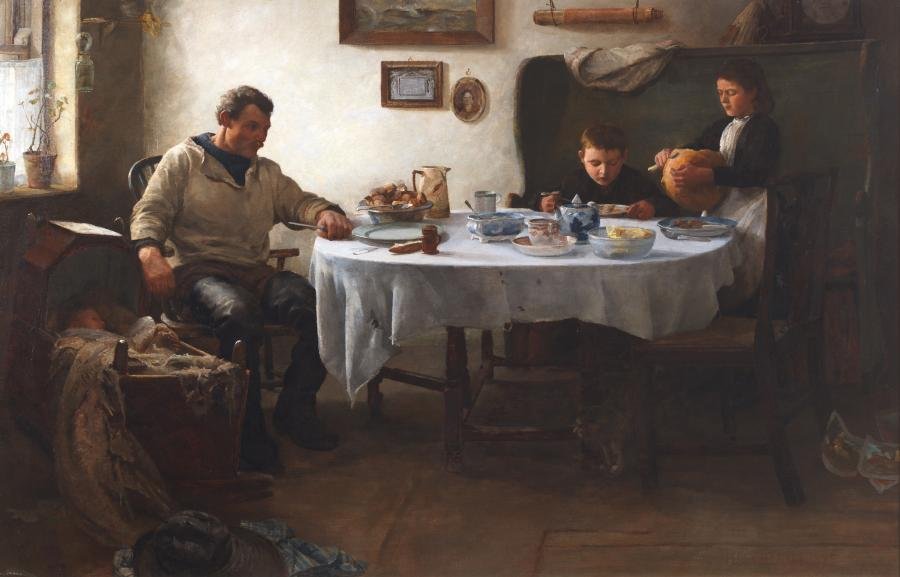
Image: The Empty Chair (1888) by Percy Robert Craft (1856-1934), Burlington House / Public Domain
Annie Ernaux, winner of the 2022 Nobel Prize in Literature, begins her memoir, The Other Girl, written in the form of a letter, with a description of a photograph of an infant in an embroidered dress. The description ends with these startling words: “When I was little, I believe—I must have been told—that the baby was me. It isn’t me, it’s you.” (Italics mine.) [1]
The “you” Ernaux addresses in her letter is Ginette, her older sister who died two and a half years before she was born. Ernaux’s parents refer to Ginette as “the little saint” up in heaven. She, Annie, is labeled “scruffy,” the nasty one who can never live up to her hyper-idealized dead sister. As the author continues to study the photograph, she names the physical differences between herself and her sister, further establishing her own identity separate from Ginette, the ghostly presence that haunted her childhood. Though Ernaux never uses the term “replacement child,” The Other Girl depicts the author’s personal experience of the phenomenon, and the burden of fulfilling the expectations of parents grieving the death of a sibling.
WHAT IS A REPLACEMENT CHILD?
One way parents assuage their grief following a loss is to conceive another child to replace the absent one. The new child comes into the world burdened with taking the place of a lost life. Many, like Ernaux, feel they can never measure up to the sainted lost sibling. Parental expectations that the substitute child bring them joy and fulfillment burden that child with an impossible goal: to heal the ungrieved sorrow of her parents.
In 1964, psychologists Albert C. Cain and Barbara S. Cain created the term “replacement child” to describe a child born to replace another who has died.[2] Kristina Schellinski is a psychotherapist and Jungian analyst who specializes in working with adult replacement children. In her book Individuation for Adult Replacement Children: Ways of Coming into Being, she broadens the definition to refer to “any child conceived to replace a child or other family member, or who was born shortly after such a loss, or who replaced a sibling, family member or other significant person during the years growing up.”[3]
In her decades of helping adult replacement children discover their unique and individual identity, Schellinski has refined her diagnosis of the replacement child condition. It now includes “a child born shortly after a death, stillbirth, miscarriage, or abortion; a child who is born as a surviving twin or multiple; a child who replaces a sibling or another member of the family later on, due to death or disability; a child who, in the context of the adoption of a child, is replacing or replaced by a conceived child; or who was assigned the role to replace a missing person or self-identified with such a role.”[4]
Wars, natural disasters, epidemics, and genocides are sometimes followed by a “baby boom” as occurred after World War II. The replacement child may bear the name of an ancestor to honor that person and the family lineage.
Not every child born after the death of a sib or a miscarriage becomes a replacement child. When parents consciously grieve and consciously choose to conceive another child not as a substitute, that child’s existence will not bear the weight of the family’s emotional trauma.
In her comprehensive book, Schellinski offers a deep dive into the complex psychological issues that may beset adult replacement children. She notes we have an instinct to shorten or evade the mourning process and to counter death with life. However, one child cannot replace or substitute for another child, and the attempt to dismiss the process of mourning in favor of new life can lead to a traumatic situation for the entire family. As evidenced in her therapeutic practice with adult replacement children, Schellinski’s clients suffer from symptoms in mind, body, and soul—depression, anxiety, suicidal thoughts, physical ailments—and seek to discover their own unique identities.
Psychologists Cain and Cain write, “the new child, the substitute, is born into a world of mourning. . . The parents grossly impose the identity of the dead child on the substitute.”[5] The key areas of distress affecting adult replacement children are identity, self-esteem, survivor’s guilt, and attachment problems.
In 1980, Robert Krell and Leslie Rabkin established three different models of the replacement child.[6] All three models involve nuanced problems of identity and individuation.
The Haunted Child: This child grows up in a family weighted by the unspoken presence of grief, guilt, and silence. The presence of the deceased sibling haunts the atmosphere. The replacement child struggles with feelings of inadequacy and is unable to live up to the idealized version of the deceased child.
The Bound Child: This child is considered precious and is stifled by parental overprotection to guard against all harm. She feels obligated to honor the memory of the lost sib and turns away from her own independence and potential, which can lead to feeling trapped and overly responsible for her parents’ wellbeing.
The Resurrected Child: This child is treated as a reincarnation of the dead sibling. The new child must lead a dual life: her own and that of the missing sibling. She carries the hopes and dreams the parents had for that child.
AN UNDER-RECOGNIZED CONDITION
Ten to twenty percent of women in the United States experience miscarriages, though the rate may be higher due to undetected pregnancies. One in 150 women experiences a stillbirth. Among other high-income countries, the U.S. ranks at the bottom of the list for infant mortality, 33 out of 38. The loss of a child or pregnancy is a heartbreaking and not uncommon experience. It calls into question our assumption about the natural order—that our children will outlive us. Monumental loss affects us deeply. When confronted with life’s unpredictability and the shocking circumstance of the unexpected death or illness/disability of a child, despair can snuff out our desire for living. Unattended sorrow, a phrase coined by spiritual teacher Stephen Levine, has consequences not only for the grieving mother but for the entire family and for future generations of that family. Dr. Rachel Yehuda, a professor of Psychiatry and Neuroscience at Icahn School of Medicine at Mount Sinai, investigates how trauma can be passed to future generations and not just psychologically. Her studies support the idea that trauma is not simply a memory, but can be encoded in our biology, impacting our health and wellbeing.[7]
Some of us come into life knowing we bear the burden of being a substitute for a deceased sib or relative. Others of us go through life unaware that our mother may have had several miscarriages before our conception or that another child had existed and died. The living sib may feel haunted, as did Ernaux, or she may never feel herself completely, as if her true self is hidden by a shadow. She may feel her personality is altered by “another.”
Unacknowledged grief and the instinct to create a new life after a loss are not pathological conditions but expressions of love and the willingness to love again after a loss. Spiritual traditions teach us that suffering is part of life and that despair need not be a permanent condition. Many famous creative people, including Beethoven, Salvador Dali, Jung, Freud, Maria Callas, and Frida Kahlo, were replacement children. In my next post, I’ll explore the relationship between the replacement child and creativity.
[1] Ernaux, Annie, The Other Girl, 2025. Translated by Alison L. Strayer. Seven Stories Press
[2] Cain, A.C., and B.S. Cain, “On Replacing a Child,” Journal of the American Academy of Child Psychiatry, 1964:Jul:3:443-456
[3] Schellinski, Kristina, Individuation for Adult Replacement Children: Ways of Coming into Being, 2020, Taylor & Francis, p. 1.
[4] Ibid., p. 21
[5] Ibid., pp. 445-446
[6] Krell, Robert; Rabkin, Leslie (1979-12-01). "The Effects of Sibling Death on the Surviving Child: A Family Perspective". Family Process.
[7] Yehuda, Rachel, and Amy Lehrner, “Intergenerational transmission of trauma effects: putative role of epigenetic mechanisms,” World Psychiatry, 2018 Sep 7 pp 243-257
If you found this post interesting, you may also want to read:
