Who Do You Think You Are? What Is Your Personal Myth?
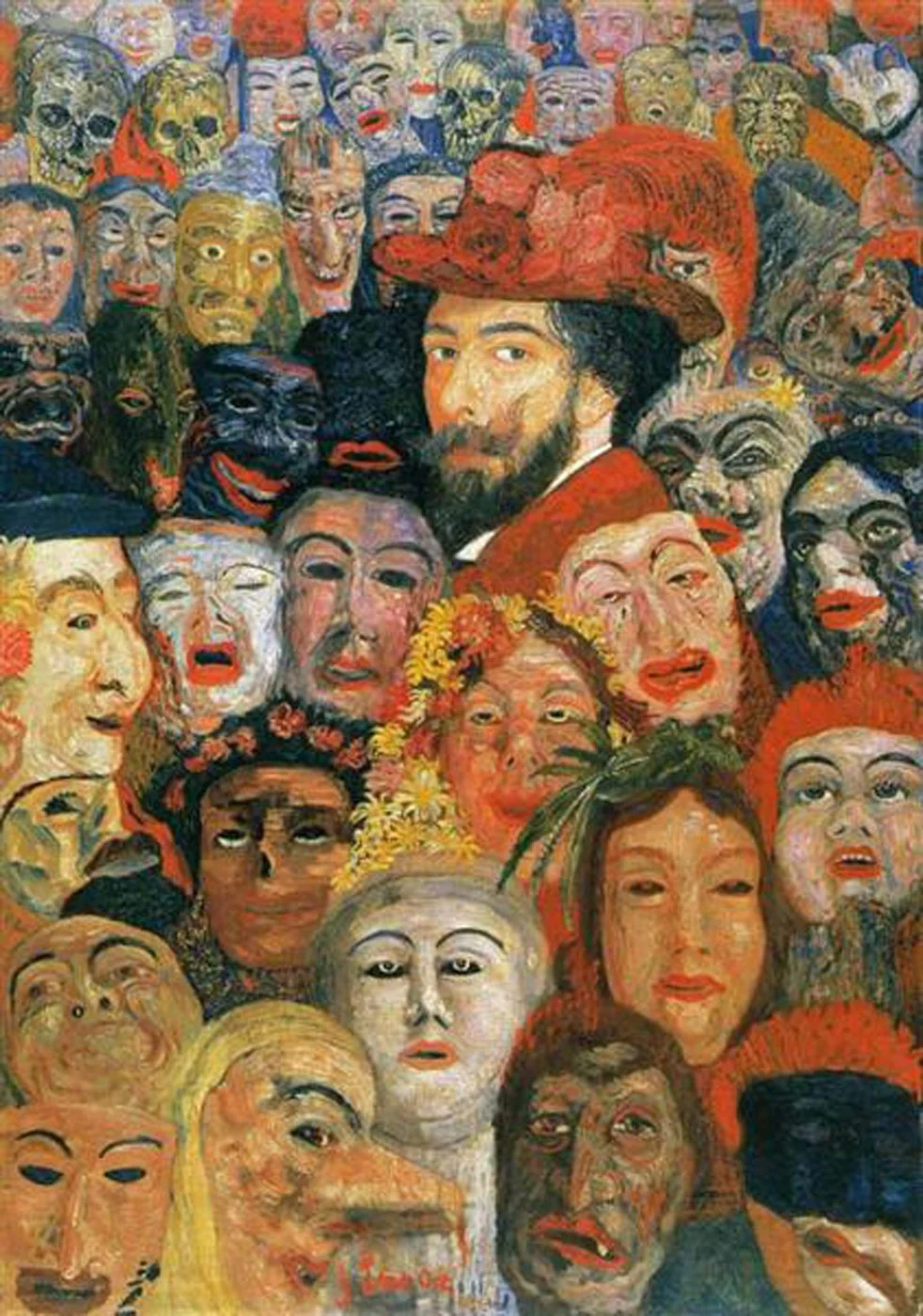
Image: Self-portrait with masks (1899) by James Ensor (1860̅-1949) Monard Art Museum, Komaki, Japan / Public Domain
Our inner world is abuzz with thoughts, visual and auditory memories, fantasies, dreams, recollections, urges, ruminations, and desires. From these fleeting and incoherent phenomena, which are only partially conscious, we form our idea of self: who we are and what characterizes us as individuals. We impose order on these random mental ephemera. We try to create a coherent narrative sequence.
A personal mythology is a mental narrative structure that gives meaning to our past, guides the present, and directs the future. We construct personal myths by organizing and condensing memories into a story that transforms the disparate bits into a logical sequence that helps us see ourselves as intelligible and knowable, as if we were characters in our own novel.
An addiction counselor might recognize she comes from a long line of alcoholics and consciously choose to break the pattern and use her personal myth to encourage sobriety in her clients. The child of immigrants might have a personal myth about the legacy of displacement that has made him determined to protect American democracy. Cultural icons Jennifer Lopez, Dolly Parton, Oprah Winfrey, and Steve Jobs share a rags-to-riches personal myth. Through determination and luck, these figures overcame impoverished backgrounds to become some of the wealthiest and most successful businesspeople on the planet.
In his Substack essay, psychologist Dan Akerfeld describes the process of constructing a personal myth:
“Narrative identity is ‘a person’s internalized and evolving life story, integrating the reconstructed past and imagined future to provide life with some degree of unity and purpose’[1]. It is a product of the human mind’s ceaseless desire to pattern-match and generalize; by drawing upon dominant cultural narratives, our interpretations of our experiences, and our imagined future, we are able to construct a coherent personal myth about who are and where we are going. This personal myth is something that is uniquely human—other animals have traits, and some even have character adaptations, but only humans can mythologize.”[2]
Let’s pause here for you to jot down what you think your personal myth is at this moment. How do you describe yourself to yourself? To others? What’s missing from these descriptions?
Cultural icons aren’t the only ones to navigate by personal myths. Most of us have an internal image of who we are, where we came from, and where we are headed. Stanley Krippner, an early investigator of dreams and the unconscious, believed our personal mythology is not only closely tied to our heredity and family but also to the prevailing myths of our culture. He wrote: “Personal myths . . . serve the functions of explaining, guiding and sacralizing experience for the individual in a manner analogous to the way cultural myths once served those functions for an entire society.”[3] Cultural myths can reflect national aspirations—America, the land of the free; Nazi Germany, an Aryan nation—as well as tribal, religious, racial, and ethnic identity.
But like memory, which is not fixed and static, our personal myth is mutable, adaptable, and evolving. Lifestyles change, we mature. Krippner continues: “If personal myths are largely unconscious, how do they affect people in their daily lives? The quality and direction one's life takes is a product of the choices made every day. Personal mythology forms the foundation of these choices because it determines how one perceives, feels, thinks, and makes assumptions about what actions will cause what outcomes.”[4]
The pain of trauma is like a nail driven into the soul. The harm and hurt of survivors can become their self-defining personal mythology to the exclusion of other important aspects of self and experience. Strong emotional experiences create more lasting memories because they are encoded in and activate deeper parts of the brain.
As a daughter of a Holocaust survivor, Dr. Daniela Schiller, a researcher at Icahn School of Medicine at Mt. Sinai, became interested in how fearful memories are stored in the brain. In 2010, she published a landmark paper that shed light on a neurological process called “reconsolidation,” in which memories become subject to change when they are recalled, including strong emotional memories.[5] In recent years, she has explored the power of imagination and mindfulness to alter the intense emotions associated with painful memories. Dr Schiller and other neuroscientists tell us that each time we retrieve a memory, it is not “replayed” in exactly the same way but is reconsolidated anew. [In previous posts, I interviewed Dr. Schiller about her work. See “How the Brain Stores Traumatic Memories,” “Memory and Trauma: We Are More than What We Remember,” and “Why Trauma Affects Some People Differently than Others.”
Our personal myths are largely constructed from autobiographical memories. As these memories are re-visioned, how we define ourselves can and does change, which in turn affects and guides our future choices and gives new meaning to our lives. Rather than a self narrowly defined by the challenges faced, our expanding personal myth might include moments of inspiration and wonder from the natural world—When I walk in the woods, I feel fully alive—or reflect a connection to others— I am the person friends contact when they need emotional support.
What is the hidden light within you that wants to be seen? What are the moments of awakening that you can re-remember? What has slipped from your memory that wishes to be reclaimed—and might be added to your personal myth?
[1] McAdams, Dan P. and Kate C. McLean, “Narrative Identity,” Current Directions in Psychological Science, June 4, 2013
[2] Akerfeld, Dan, “The Stories We Tell: Myth, Memory, and the Self,” Mind & Mythos, May 4, 2024
[3] Krippner, Stanley, “Dreams and the Development of a Personal Mythology,” The Journal of Mind and Behavior, Spring and Summer 1986, p. 449
[4] Ibid., p. 455
[5] Schiller, D., et al, “Preventing the return of fear in humans using reconsolidation update mechanisms,” Nature, December 9, 2009
If you found this post interesting, you may also want to read
