Fierce Attachments: On the Companionship of Books
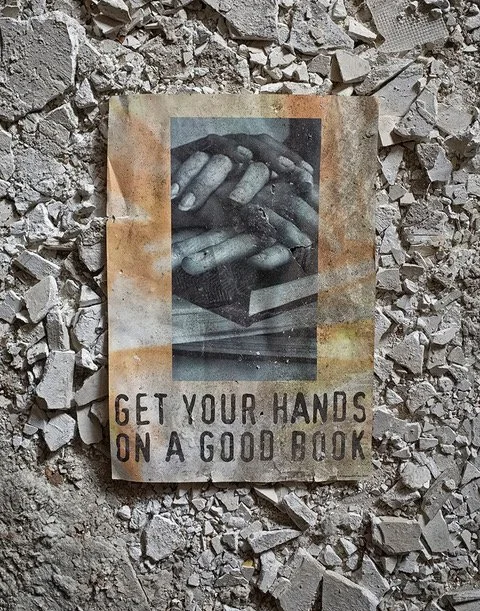
Untitled, found at a Detroit school, Photo: Brenda Manthe.
This is my first “Letter from Dale” in the new year. Before I begin, I want to tell you how grateful I am for your responses to this shared space. I love hearing from you, knowing we are exploring this time together on the planet. What interests you interests me. Other minds wake me up. My writing would be an act of self-absorption without the revelations of others.
This letter reflects on books as lifelong companions—sources of meaning, moral formation, and resistance to the isolations of modern technological life.
January 2026. That date would have sounded science fictiony when I was growing up, but science fiction is often prophetic and many of the fantasies about the future born in the last century have become our reality. The annual Book of Knowledge for 1955, published by the Grolier Society, forecasted a future brightened by computers, atomic energy, commercial air travel, color television, and robots capable of vacuuming floors.
In our collective imagination we saw a marvelous world-to-come, the American Dream, with its muses of capitalism, consumerism, and efficiency—happiness envisioned as technological progress. (A dishwasher and electric lawn mower for every home! Forget the millions who did not own and never would own homes.)
I remember my mother’s delight over frozen peas—no more laborious shelling, no more nicked fingers—and my own thrill at peeling the foil cover off a frozen TV dinner to reveal a slab of gray turkey meat and a lump of tasteless mashed potatoes. We truly believed that a flourishing economy and superior scientists and manufacturers made us a superior people. We conflated our so-called “progress” with moral superiority.
Not much has changed except the tchotchkes of the good life. What does it say about us as a species, I wonder, that we are always and forever bewitched by the sparkling new things technology brings and their seductive promise of ease and betterment?
How we use what we invent matters. These days, grand illusions are pinned on the perfection of AI or drones or colonies on Mars. I’m not a technophobe, but I am a technoskeptic. Why should any of us trust those who abuse their power? I want guardrails for the rich and powerful.
What shapes culture? If technology, and I mean this in the most general sense, provides new ways to manipulate the environment and restructure culture, what can we rely on to infuse us with an understanding of who we are, our longings, desires, and griefs? We are healthier and wealthier than our ancestors but feel lonelier and poorer. Poverty, a tangible reality for so many, can also manifest as poverty of spirit, that animating life force that opposes hopelessness and lethargy. In this current Dark Age, we’ve become insensitive to the ten thousand things that once filled us with delight. Like the woods behind our homes. Like fireflies and a pond at dusk. Who we become depends on where we focus our attention.
How do we restore astonishment at the radiant beauty that abounds? In this time of a crumbling empire, in this time of ruination and brokenness, can we widen our perceptions and feel ourselves to be creatures in a universe we share with other living things?
Books can help.
Books take us places we would otherwise not visit. Books introduce us to the stories of others we might not otherwise meet. Like a Zen garden, entering a book lets us step into a minimalist space that gives the feeling of vastness. Books are companions on the path. Books and the simmering awakenings they ignite. Books are texts for living.
In a 2025 New York Times opinion piece, “Before You Toss That Book . . .,” literary critic and essayist Roger Rosenblatt writes: “We may think we finish with books, but they don’t finish with us. Books are houses. Once inside, you’re transformed, and you become the house you’ve entered. . .. We read books,” he says, “and books read us.”
I, too, am writing an elegy for books. An elegy, but also a rallying cry to look again at all the things that once thrilled us with mystery and joy. An elegy for the reveries we once experienced inside the pages of a book.
I decided to make a list of books that have most influenced me and shaped who I am. The titles floated up from memory and surprised me. They aren’t necessarily the best book by the author, but they are the ones that formed my ideas and values. The list is vastly incomplete. I’ve limited the number of titles and left out most of the late twentieth- and twenty-first-century authors for lack of space.
The following books opened portals, taught me to question, to listen, to find my own words. They taught me about men, power, society, the inner workings and forces behind power structures and how they manifest. They pierced my naivete, transported me to other times and other places, enlightened me about cruelty, rescued me from boredom, dazzled me with language that is song. They invaded my mind and seeded my dreams. They are forever friends.
Books That Shaped My Values, Worldview, and Inner Life
The Epic of Gilgamesh, c. 2100 BCE, (translation by Stephen Mitchell, 2004)
The Metamorphoses, Ovid, 8 CE (translation by Rolfe Humphries, 1955)
The Prince, Niccolo Machiavelli, 1532
“Cinderella,” Histories or Tales of Times Passed, Charles Perrault, 1697
“Hansel and Gretel,” “Rapunzel,” Grimms’ Fairy Tales, Brothers Grimm, 1812 (many of my posts discuss fairy tales)
Jane Eyre, Charlotte Bronte, 1847
The Protestant Ethic and the Spirit of Capitalism, Max Weber, 1904
Concerning the Spiritual in Art; Wassily Kandinsky, 1911
The Prophet, Kahlil Gibran, 1923
Letters to a Young Poet, Rainer Maria Rilke, 1929 (translation by Stephen Mitchell, 1984) (some of my posts cite Rilke)
Man’s Search for Meaning, Viktor E. Frankl, 1946 (some of my posts cite Frankl)
The Diary of a Young Girl, Anne Frank, 1947
Residence on Earth, Pablo Neruda, 1947
Native Son, Richard Wright, 1950
Good and Evil, Martin Buber, 1952
When Prophecy Fails, Henry Reiken, Leon Festinger, Stanley Schacter, 1956
New Poets of England & America, ed. Donald Hall, Louis Simpson, Robert Pack, 1957
The Poetics of Space, Gaston Bachelard, 1958
The Other America, Michael Harrington, 1962
The Fire Next Time, James Baldwin, 1963
Man and His Symbols, C.G. Jung, 1964 (many of my posts discuss Jung)
Twelve Moons, Mary Oliver, 1979
The House on Marshland, Louise Gluck, 1975
Diane Arbus: An Aperture Monograph, 1972
On Lies, Secrets, and Silence: Selected Prose, 1966-1978, Adrienne Rich, 1979
Beloved, Toni Morrison, 1987
The Interpretation of Fairy Tales, Marie-Louise Von Franz, 1987
The Protean Self: Human Resilience in an Age of Fragmentation, Robert Jay Lifton, 1993
These books entered my life when I needed them. What books shaped you? What book would you read again? I welcome your response.
Meanwhile, tugging at my heart right now is a different book: my brand-new book which grew out of a fairy tale I'd written: Wild Freedom: The Princess Who Found Her Name – On Fairy Tales, Imagination, and the Creative Mind. It's coming from Chiron Press in May. I hope you'll be intrigued.
As always, with care and gratitude for your presence in my life,
Dale
