The Benefits and Burdens of Keeping Secrets
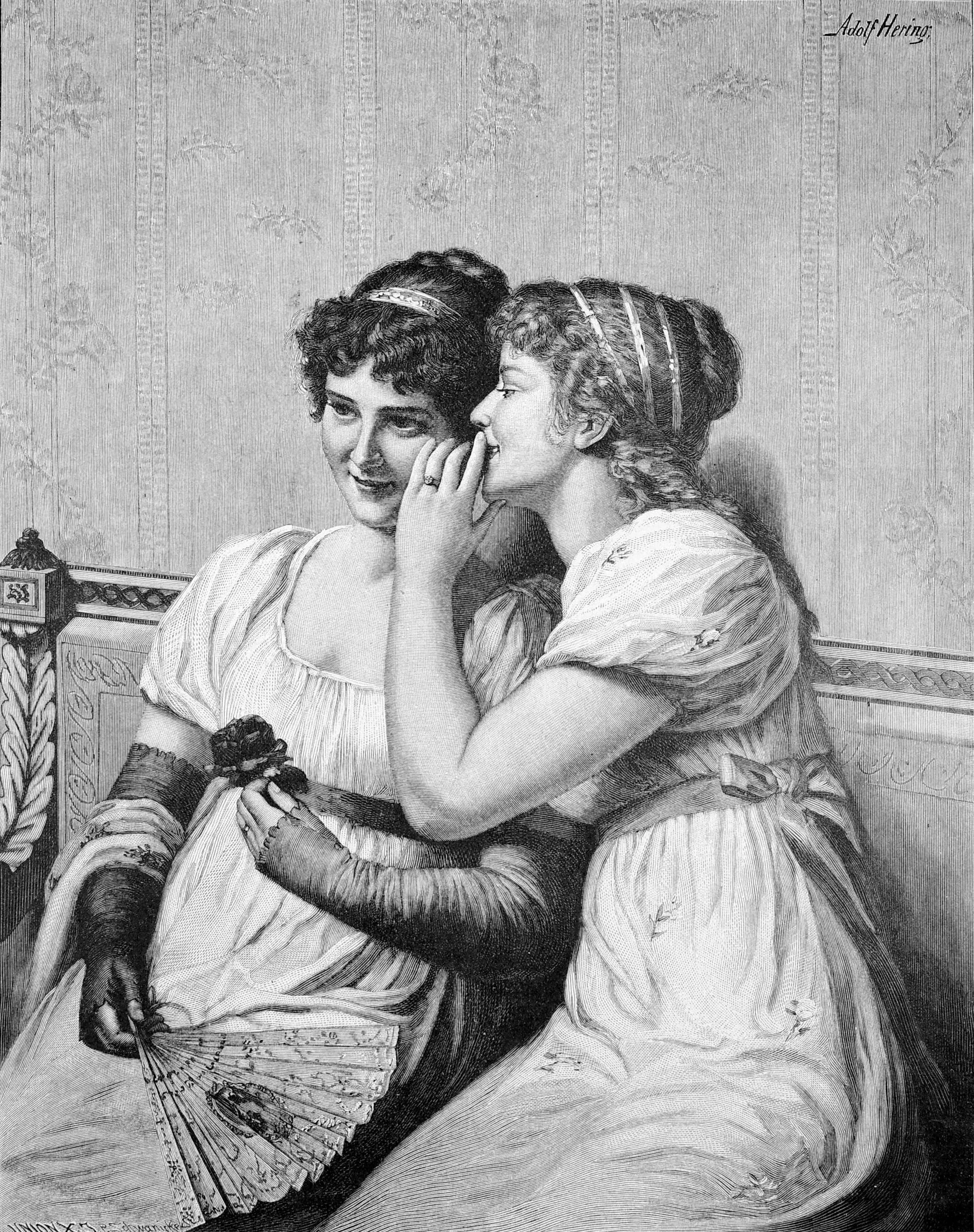
Image: "Ein Süßes Geheimnis" (A Sweet Secret) (1892) by Adolf Emil Hering (1883–1932) published in Die Gartenlaube – Illustrirtes Familienblatt (“The Garden Arbor – Illustrated Family Journal”) Kröner-Verlag / Public Domain
Once upon a time during my girlhood, I was a teller and keeper of secrets. Secrets among friends were a form of bonding, and keeping someone’s secret, a sign of loyalty. Who told you their secret, and to whom you told your secret reflected a hierarchy of trust. Best friends were lost or found on their ability to be a container for what you did not want others to know. Such is the power of secrets: to be shunned by the secret-telling circle is to feel excluded, less worthy, left out. Humans are social pack animals that thrive in small cooperative, interdependent groups. Our connection to others is crucial for our well-being, mental and physical.[1]
We all have secrets, including secrets from ourselves. The secrets we keep from ourselves are often facts about ourselves or our lives we find uncomfortable, unacceptable, even frightening. Swiss analytic psychologist Carl Jung used the term “shadow” to describe aspects of ourselves we believe are undesirable and repressed. These would include our fantasies, desires, instincts, negative feelings like anger, or positive aspects like creativity. What frightens us about ourselves, what feels endangering, we keep blocked off from our conscious mind. In other words, our private secrets.
In recent literature, popular memoirs describe the role of a victim in keeping the secret of an abusive relationship, or in protecting a predatory family member or trusted elder. Others of us keep secret our sexual orientation, gender orientation, or our mental or physical illness.[2] Something in these stories touches our own experience of unexpressed private and transgressive feelings that go against the norm. Relief arrives when we share what has been hidden, and our whole authentic self is recognized and accepted.
Secrets also intrigue us. They are a source of mystery, even excitement, and make up the structure of thrillers and true crime stories, fantasy literature, fairy tales, or fiction of the best-selling page-turner variety. Plot-driven novels succeed on the premise that readers are enthralled by chasing down a secret. Spies keep secrets, governments and nations keep secrets, presidents, prime ministers, monarchs and dictators keep secrets of state, as well as secrets that may be crimes against those they govern. Conspiracy theories thrive on secrets. The Merriam-Webster Dictionary defines “conspiracy theory” as “a theory that explains an event or set of circumstances as a result of a secret plot usually by powerful conspirators.” Though conspiracy theories often lack evidence, these add fuel to the belief that there is a secret, well-hidden, nefarious scheme.
In a 2017 study, Michael Slepian and his team of researchers identified 38 common categories of secrets that people keep about themselves, ranging from infidelity and illegal behavior to pregnancy and planned surprises for others. At any given moment, the average person has about 13 secrets.[3] One intriguing finding Slepian found was that people’s minds wander to their secrets far more often than they actively try to conceal their secrets from others. The frequency of concealment didn’t seem to have much effect on well-being, but the more people’s minds wandered to their secrets, the worse off they were.[4]
“It’s not how much you hide a secret that’s harmful, but how often you find yourself thinking about it,” Slepian said in an interview.[5]
In many circumstances, the weight of keeping a secret is burdensome, a difficult choice. We feel the risk of being judged, condemned, punished, ostracized, humiliated, and ridiculed if we believe our secret is unacceptable to others. But by keeping ourselves hidden, we risk loneliness and isolation. In our personal lives, we may keep a terminal diagnosis secret from a loved one to mitigate their worry and fear. We may keep the news of a pending divorce from our young children to spare them the prolonged pain of a family rupture. Shame and guilt visit us when we are confused about how and when to keep a secret. Ethicists, lawyers, religious leaders, and counselors of all stripes deal daily with the inner conflicts of those who need to make moral decisions on breaking the silence of a secret.
When it comes to revealing secrets, researchers make an important distinction. Revealing a secret to a person that the secret is kept from is termed confession, whereas revealing a secret to a third party is termed confiding. Little research exists on confession. Confiding, by contrast, has received more attention, and confiding secrets in others typically goes better than expected. By age six, children understand that sharing a secret with another is a signal of relationship closeness.[6]
The good news is that secrets have a positive side and can be a source of wonder and joy. In a study in 2023, Slepian and his team identified two common secrets that are uniquely positive: surprises and marriage proposals.[7] Think of the happy face of a celebrant who has just stepped into a surprise birthday party. Other secreets can be a sacred covenant with ourselves, a wish we keep secret that entails hope and faith. In fairy tales, secrets are related to magic and positive outcomes, such as knowing a secret word, or obtaining a secret talisman like a magical cape. These tropes point to a hidden world in which all things are possible. Consider the secret wonder of discovering a bird’s nest filled with sky blue eggs, or the poems written in secret to a lover, or the secret drawer in a desk where you keep a note from a beloved friend.
Let yourself dwell for a moment on the secrets you have kept, the secrets you wish to share. Are there secrets that have changed your life?
[1] Terrell, Lorraine, “The Science of Being Social,” Five University of Pennsylvania Arts & Sciences researchers explain why connections are critical not just to human happiness but also to our survival. OMNIA, May 2023.
[2] Isay, Jane, “The Secret That Became My Life,” Psychology Today, January 1, 2014.
[3][3] Slepian, Michael, et al., “The New Psychology of Secrecy,” Current Directions in Psychological Science, March 21, 2024.
[4] Slepian, Michael and Greenway, Katherine H., “The benefits and burdens of keeping others’ secrets,” Journal of Experimental Social Psychology, September 2018.
[5] Weir, Kristin, “Exposing the Hidden World of Secrets,” American Psychological Association Monitor, September 1, 2020.
[6] Nguyen, C, Slepian, M.L., “Revealing Secrets,” Current Opinion in Psychology, October, 2022.
[7] Slepian, Michael, Greenaway, K.H., Camp N. P., Galinsky, A.D., “The bright side of secrecy: The energizing effect of positive secrets,” Journal of Personality and Social Psychology, November, 2023.
If you found this post interesting, you may also want to read:
